DEDP master's students standing in a line in classroom

Master in Data, Economics, and Design of Policy (DEDP)

The fight against poverty and inequality is more data-driven than ever before. Producing and understanding rigorous evidence has become increasingly critical for those seeking to affect change globally, but opportunities to acquire these skills remain limited. As the first master’s degree to be offered by MIT’s Department of Economics, the Data, Economics, and Design of Policy (DEDP) program is designed to meet this rising demand. Jointly run by the Economics Department and the Abdul Latif Jameel Poverty Action Lab (J-PAL), the program equips development professionals from across the globe with the practical skills and theoretical knowledge needed to tackle some of the world's most pressing challenges. 

Our program draws students with a wide range of backgrounds. Whether they focus on policy, practice, or further academic study, our graduates go on to impactful careers in the development sector and government.

The DEDP program offers two tracks: 

  • The International Development Track allows learners to apply the tools acquired through the core courses to explore development issues that are most prevalent in low- and middle-income countries experiencing massive and persistent poverty. 
  • The Public Policy Track allows learners to build on the tools acquired through the core courses to address a range of public policies, including both local issues and those that transcend geographic boundaries.
Innovative admissions model

The DEDP program employs a unique approach to admissions. Before applying, all students must first successfully complete the online MITx DEDP MicroMasters credential. No other standardized tests such as the GRE or GMAT are required to apply.

Learners admitted to the DEDP program complete one semester of coursework at MIT and an approved capstone. Graduates of the program earn a Master of Applied Science in Data, Economics, and Design of Policy from MIT.

This innovative approach to admissions has drawn students from nontraditional backgrounds who not only excel at MIT but also inspire the community with their drive and passion for improving the lives of millions around the world.

A student body that reflects the demographics of the world at large will be better poised to implement change for good worldwide. Esther Duflo, Faculty Director of the DEDP program

DEDP network at a glance

DEDP master's students come to MIT from across the globe, bringing with them different perspectives that are shaped by their life experiences. Learn more about our current students.

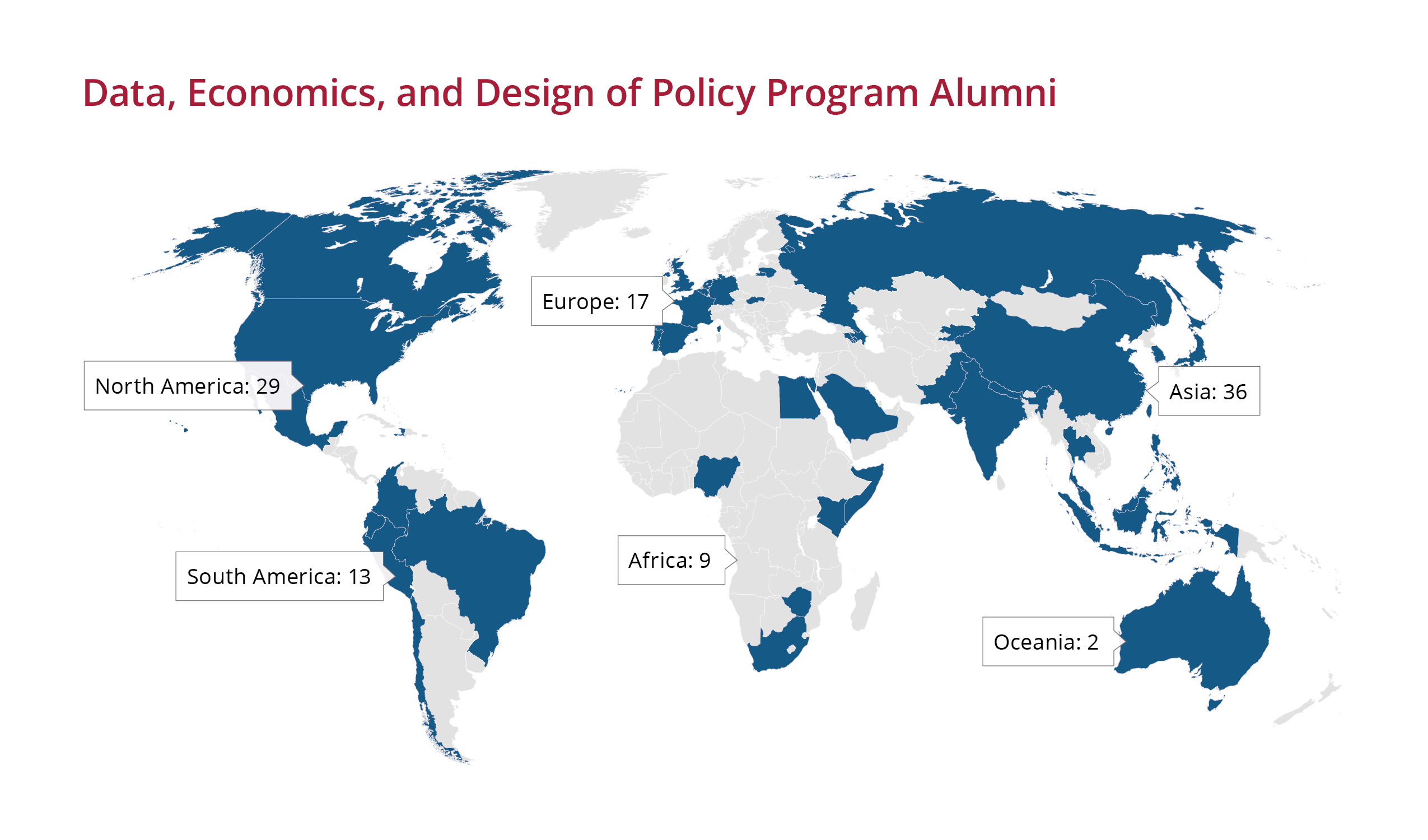
Each class joins a vibrant community of DEDP alumni who are deeply committed to using evidence-based approaches to alleviate poverty around the world. To date the program has graduated over 100 students from 45 countries. Whether they focus on policy, practice, or further academic study, our graduates go on to impactful careers in international development and public policy.  

World map with countries highlighted to represent the global reach of our alumni, including nations from North America, South America, Europe, Asia, Africa, and Oceania.

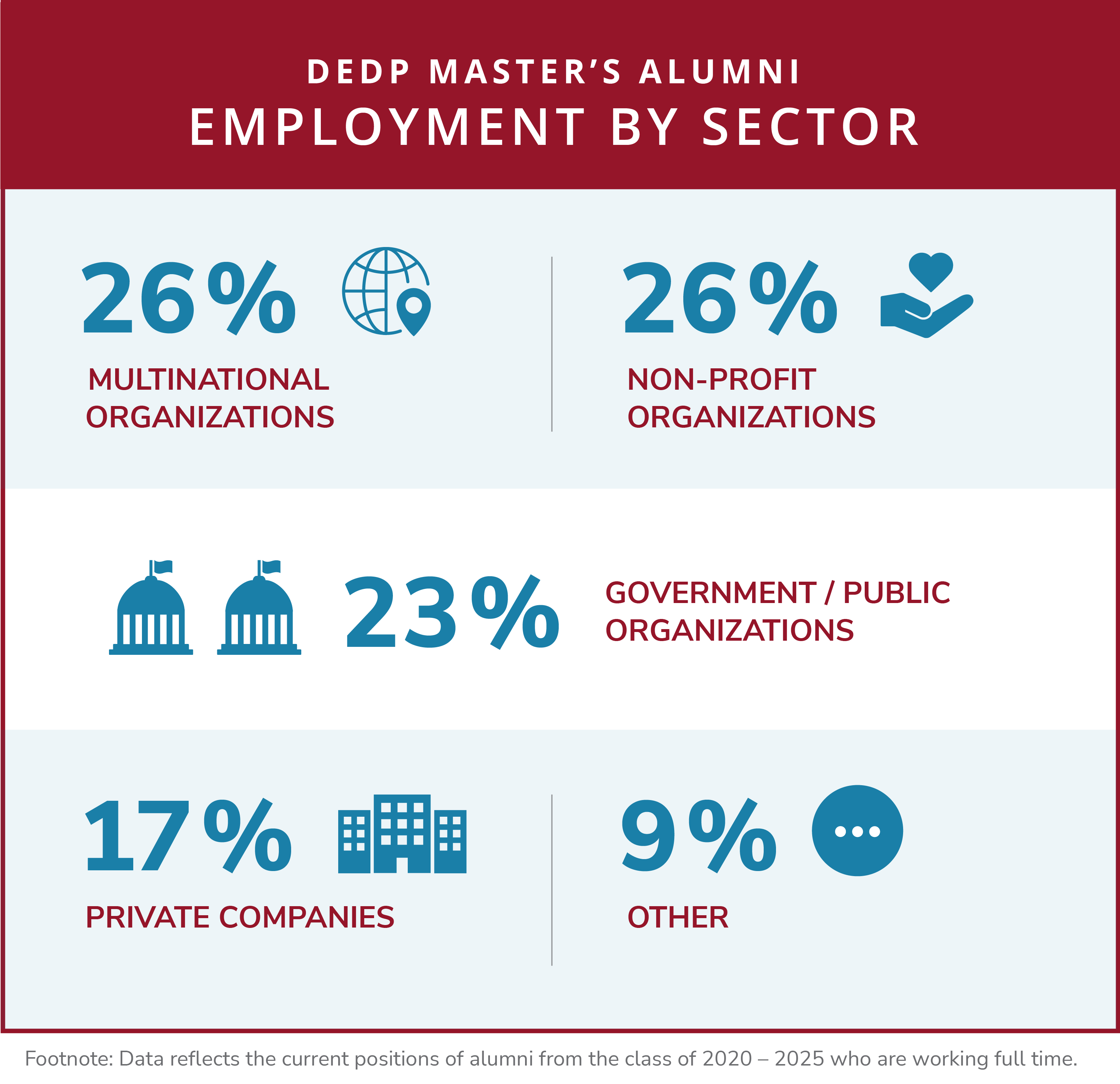
Approximately 25% of alumni have pursued a PhD or other academic program, and 70% are working professionals across a range of sectors. An additional 2% are pursuing predoctoral fellowships and 3% are engaged in other opportunities.


Graphic displaying percentages of DEDP master's alumni employment by sector.
"These have been some of the best months of my life. I've learned a great deal and met very interesting people who are really on the edge of human knowledge when it comes to economics and doing world-class research." Tomas Dulka, DEDP Class of 2022