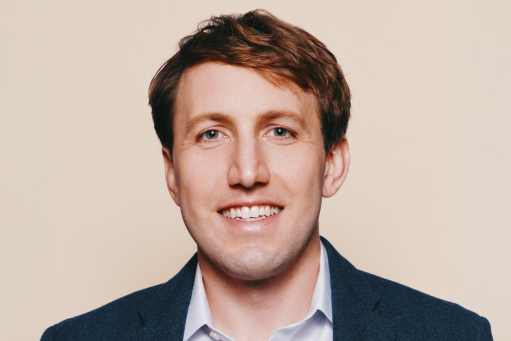
Otis Reid ‘18 is the Executive Director of Global Health and Wellbeing for Coefficient Giving, a philanthropic funder and advisor that uses research and strategic guidance to help donors maximize the impact of their philanthropy. Here, he shares more about his post-PhD career path, his current work at Coefficient, and how the tools from his economics training have shaped each step along the way.
When Otis Reid completed his PhD in 2018, he didn’t follow the most predictable path for a newly minted economist. At MIT, Reid’s doctoral work focused on topics in political economy and development, and his examinations of anti-corruption initiatives and political behavior involved fieldwork in the Democratic Republic of the Congo and Uganda. But rather than heading to academia, Reid took his doctoral training into the world of data-driven political strategy and, later, to his philanthropic advising and grantmaking work at Coefficient Giving.
The analytical thread
After graduation, Reid joined analytics consulting firm BlueLabs, focusing on campaign strategy and evaluation. Reid’s time in political work sharpened his appreciation for how an economics background could be applied to real-world questions. “There’s a ton of value in data-driven approaches to politics, especially in helping frame problems more precisely,” he says. “For example, people are generally familiar with swing states, but data lets us answer far more precise questions: What’s the gradient across these states? How do you account for the fact that each vote carries less weight in larger states when you’re thinking about where to invest more funding?”
His work also drew on a substantial body of research on what actually moves votes. “Being able to interpret and evaluate that research critically drew heavily on my economics training,” says Reid, “and I found that extremely valuable in political strategy work.”
In 2021, he joined Coefficient Giving, where he began by researching potential new cause areas. His role expanded over time, and today, he oversees a broad portfolio of funds spanning global health and development, policy advocacy, and farm animal welfare.
Looking back across these chapters, Reid sees a clear unifying instinct. “The main through-line across my work has been using data and analytical rigor to inform the best possible decisions. Economics has been a powerful lens for that. It provides a strong set of tools that are incredibly valuable for evaluating evidence and making decisions.”
Where a dollar does the most good
At Coefficient Giving, Reid and his colleagues confront a deceptively simple question: where can a dollar do the most good? Coefficient directed more than $1 billion in 2025, and their framework for maximizing the impact of those funds relies on three pillars: importance (how big the problem is), neglectedness (how much effort is already going into solving it), and tractability (how solvable the problem actually is).
“Different problems score quite differently on these dimensions, and we’re looking for ones at the Pareto frontier of these criteria,” Reid explains. Some pieces are relatively easy to pin down. Research can usually provide a reasonable sense of how many people a disease kills, for example, and it’s often possible to identify the largest funders currently working in a given area.
“The trickiest piece is usually tractability,” he says. “Is a problem neglected because it’s genuinely hard to solve, or is it neglected because no one’s really tried? Sorting that out is where a lot of the action is.” It’s a question that requires not just data, but judgment, and it’s an area where Reid’s economics training proves valuable. His background lets him critically evaluate the large body of social science research that can be helpful for thinking about the scale of various problems.
Reid also notes that economics, for all its power, has limits in his current work. “The particularities of many causes rely on skills further afield from economics,” he says. “If we’re evaluating a new vaccine platform, the scientific history of the field may matter enormously, and economics alone won’t provide those answers.” Even then, economics often reemerges as a helpful lens for evaluating structural aspects of an issue, such as profitability explanations for why big pharma companies might not have invested in a vaccine before.
The MIT foundation
Ask Reid what aspects of his time at MIT Economics have most shaped how he thinks today, and he first points to the core economic framework. “Thinking about incentives, constraints, and problems as constrained optimization problems — that mindset still informs how I approach decisions and think about the role of philanthropic capital in fixing problems [and creating good].”
Equally formative were the econometric tools he picked up, which have proved valuable for understanding the strengths and weaknesses of social science research. He remembers the classes taught by Josh Angrist as especially helpful for building intuition around credible identification strategies and empirical rigor. This is key for Reid’s work at Coefficient Giving, where he draws heavily on research to evaluate causes and interventions. Conducting his own research, he adds, shaped how he thinks about replication and corroboration — checking claims across multiple sources and valuing evidence that holds up under scrutiny.
Reid also credits his coursework more generally with encouraging creative thinking and providing exposure to topics that are relevant for his work today, especially in development economics. Economics also offers an invaluable lens on incentives, which has proved particularly helpful for Reid’s work at Coefficient. “If private-sector actors already have strong incentives to solve a problem and still haven’t solved it, that raises an important question: why do we think philanthropy will succeed where markets haven’t? What’s the missing ingredient?” That kind of thinking, he says, helps his team avoid jumping into problems too quickly.
For current students drawn to global problems but unsure whether to pursue academia, government, or philanthropy, Reid's advice is simple: work on problems you genuinely find interesting. “Life is long, grad school is long, and you spend a huge amount of time thinking about your research,” he says. “If you're deeply interested in the questions you're working on, it's much easier to stay motivated and pivot naturally if needed.”
Looking ahead
Today, Reid has plenty to look forward to. At Coefficient Giving, he points to the Global Growth Fund as an initiative with exciting potential. Launched last year and led by Justin Sandefur, formerly of the Center for Global Development, and economists Rafael Latham-Proença and Oliver Kim, the program focuses on reducing poverty by accelerating economic growth in low- and middle-income countries.
He's also focused on the massive transition underway in foreign aid, particularly health aid. Coefficient Giving’s Global Aid Policy Program works to encourage more and better aid while helping countries manage these changes. "I think getting this transition right will matter significantly for the trajectory of global health," says Reid. Increasingly, he's also thinking about how AI may reshape global health and development.
Outside of work, Reid finds a little time for good documentaries, most recently Queen of Chess about Hungarian chess prodigy Judit Polgar. Much of his time is also spent with his two kids, aged five and two (with a third expected later this year). His youngest has grown more vocal in recent months, he notes, and watching the two siblings engage on a deeper level "has been special to watch."